Your Complete Guide to Abdominal Muscle Strain Recovery
You’ve probably heard someone talk about a “pulled stomach muscle.” That’s just another name for an abdominal muscle strain, which is what happens when you tear or overstretch one of the muscles in your core. It's usually caused by a sudden, awkward movement or just plain overuse, and it brings on a sharp pain that loves to make itself known every time you cough, sneeze, or twist.
A Quick Tour of Your Abdominal Wall Anatomy
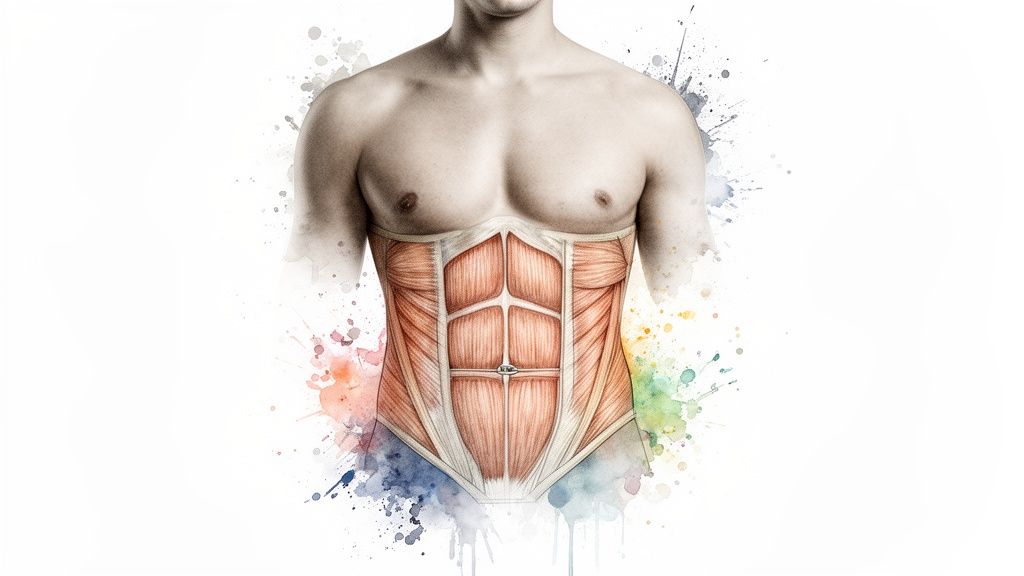
To really get a handle on what an abdominal strain feels like and why it happens, it helps to picture your core. Don't think of it as one big muscle. Instead, imagine a dynamic, multi-layered corset that wraps snugly around your midsection. This intricate system is your body’s powerhouse, working around the clock to keep you stable, support your spine, shield your organs, and let you move freely.
These layers are your silent partners in everything from the simple act of sitting up in bed to the explosive power needed to swing a tennis racket. When you injure just one of these layers, the whole system feels it.
The Key Players in Your Core
Your abdominal wall is made up of three main muscle groups, and each one has a very specific job:
- Rectus Abdominis: This is the one everyone knows—the "six-pack" muscle. It runs straight down the front of your torso from your ribs to your pelvis. Its main job is to flex your spine, which is the exact motion you use when doing a crunch.
- Obliques (Internal and External): You'll find these muscles running along the sides of your torso. They’re in charge of all your twisting and side-bending movements. Think about the rotation needed for a golf swing or throwing a baseball; that's all thanks to your obliques.
- Transversus Abdominis: As the deepest layer, this muscle acts like your body's own built-in weight belt. It wraps horizontally around your trunk, firing up to stabilize your spine and core before you even begin to move.
An abdominal muscle strain happens when the fibers in any of these muscles get stretched past their breaking point and tear. It’s a lot like a rubber band that’s been pulled too far and finally snaps. The damage can be anything from tiny, microscopic tears to a complete and painful rupture.
How Bad Is It? Understanding Strain Severity
To figure out the best way to treat a pulled muscle, healthcare providers classify strains into three different "grades." This system helps them understand the extent of the damage and create a recovery plan that’s right for you.
To give you a clearer picture, here’s a quick breakdown of what each grade means.
Quick Guide to Abdominal Muscle Strain Grades
| Strain Grade | Description | Common Symptoms |
|---|---|---|
| Grade I (Mild) | A minor overstretching or slight tearing of the muscle fibers. The muscle is tender but still has normal strength. | Mild pain and tenderness, slight swelling, and minimal loss of function. You can still move, but it's uncomfortable. |
| Grade II (Moderate) | A partial tear of the muscle fibers. This is a more significant injury with noticeable strength loss. | Moderate pain that gets worse with movement, visible swelling or bruising, and a clear loss of strength. |
| Grade III (Severe) | A complete tear or rupture of the muscle. This is a serious injury that often results in a total loss of muscle function. | Severe, sharp pain, significant swelling and bruising, and the inability to use the muscle at all. Sometimes a "pop" is felt or heard. |
Knowing the grade of your strain is key. It helps set realistic expectations for your recovery and ensures you’re not pushing yourself too hard, too soon.
A strain's grade has a direct impact on your healing timeline. A mild Grade I injury might feel better in a couple of weeks with rest. A severe Grade III tear, on the other hand, could take several months to heal properly and might even require more intensive medical care to get you back to normal.
This classification isn't just medical jargon; it's a road map for your recovery, guiding you on how to safely and effectively heal your injury.
Common Causes and Who Is Most at Risk
An abdominal muscle strain doesn't just happen out of the blue. It’s almost always the direct result of forces overwhelming your core muscles, either from one single, powerful event or from the slow accumulation of stress over time.
Think of it as a sudden shock to the system or a gradual wearing down of your muscular defenses. The most common culprits are explosive actions that demand a sudden, forceful contraction of your abdominal wall. These movements stretch and contract the muscle fibers faster than they can handle, leading to those tiny, painful tears.
On the other hand, a chronic strain is more subtle. This happens when you perform the same motion over and over without giving your muscles enough time to heal and recover. This constant stress gradually weakens the muscle fibers, leaving them vulnerable to injury even during routine activities.
High-Intensity Activities and Overuse
Certain activities dramatically increase your odds of pulling a stomach muscle simply because of the intense demands they place on the core.
- Sudden Twisting: Sports like tennis, baseball, and golf are prime examples. They all require rapid, powerful torso rotation that puts immense strain on your oblique muscles.
- Intense Exercise: Pushing for too many crunches or leg raises, especially if your form isn't perfect, is a classic path to an overuse injury.
- Improper Lifting: We’ve all heard it: "lift with your legs, not your back." Using your back and core to hoist a heavy object is a textbook recipe for a strain.
- Unexpected Slips or Falls: When you start to lose your balance, your body’s automatic response is a forceful, often awkward, contraction of your core muscles to try and stabilize you.
It's surprising, but even something as simple as a violent coughing fit or a powerful sneeze can generate enough internal force to strain the abdominal wall. These reflexive actions are incredibly powerful and can catch your muscles completely off guard.
Profiling High-Risk Groups
While anyone can pull a stomach muscle, some people are definitely more vulnerable because of their job, hobbies, or physical condition. Athletes are a primary high-risk group, especially those in sports that involve a lot of throwing, swinging, or sprinting.
Military personnel also face a significant risk. The intense physical demands of training—think obstacle courses and grueling drills—contribute to a high number of these injuries. In fact, one study of military trainees found that 58.8% reported an abdominal muscle strain, a rate far higher than for other musculoskeletal injuries. The severity is also a major issue, with 30.4% of those injured having to suspend their training. You can read more about the study's findings on military training injuries.
Key Takeaway: An abdominal muscle strain is not just an athlete's injury. It can affect anyone who pushes their core muscles beyond their current capacity, whether through a single forceful event or repetitive strain over time.
Beyond athletes and soldiers, individuals with weakened core muscles, poor posture, or a history of previous abdominal injuries are also more predisposed. Fatigue is another huge factor. Tired muscles are less able to absorb shock and maintain stability, making them much, much easier to injure.
How to Recognize the Signs of a Strain
Figuring out if you have a pulled abdominal muscle versus some other kind of stomachache can be surprisingly tricky. We often think of a sudden, sharp pain during a specific movement as the telltale sign, and while that's common, the symptoms are often more complex. Knowing what to look for is the first step toward getting the right care and, just as importantly, not making the injury worse.
The pain from a strain is usually very specific—so much so that you can often point to the exact spot that hurts. This discomfort will flare up anytime you use your core muscles. Simple actions like laughing, coughing, sneezing, or even just sitting up can trigger a sharp, localized ache.
Telltale Signs of a Pulled Abdominal Muscle
Beyond that initial jolt of pain, a true muscle strain comes with a few other physical clues you can see and feel. These signs help confirm the problem is with your muscles and not something deeper inside.
- Localized Tenderness: The injured spot will probably feel sore and tender if you press on it gently.
- Swelling or Bruising: For more significant tears (Grade II or III), you might notice some visible swelling or even a black-and-blue mark developing on your abdomen.
- Muscle Spasms: It's common for the injured abdominal muscles to involuntarily cramp or twitch as a protective response.
- Stiffness and Weakness: Your whole core area might feel tight, making it tough to bend or twist. You'll likely also notice a real sense of weakness when you try to use those abs.
Here's a key distinction: Pain from an abdominal muscle strain is directly tied to muscle use. It gets better when you rest and worse when you move. Pain from an internal issue, like a stomach bug or appendicitis, tends to be more constant and doesn't change much whether your muscles are working or not.
When to Seek Immediate Medical Attention
Most abdominal strains get better with time and rest, but there are a few "red flag" symptoms you should never ignore. These can signal a more serious problem, like a hernia, an issue with an internal organ, or a complete muscle rupture that needs urgent evaluation.
Give your doctor a call or head to an urgent care facility if you experience any of these:
- Severe, Unrelenting Pain: This is pain that doesn’t ease up with rest or is so intense that you can't go about your day.
- A Visible Bulge: If you see a noticeable lump or bulge under the skin, it could be a hernia—where an organ or tissue is pushing through the weakened muscle wall.
- Fever with Abdominal Pain: This combination is a classic warning sign of an internal infection, such as appendicitis.
- Inability to Move: If the pain is so bad that you can't walk or even have a bowel movement, it's time to get help right away.
How Doctors Figure Out If It's an Abdominal Strain
Getting to the root of your abdominal pain is the crucial first step toward getting better. Your road to an accurate diagnosis almost always starts with a simple conversation and a hands-on physical exam with your healthcare provider.
They’ll want to hear the whole story: exactly how the injury happened, what the pain feels like, and what specific movements make you wince. This isn't just small talk; it's detective work.
The Physical Exam: A Hands-On Approach
The initial check-up involves more than just questions. Your provider will gently press on different spots around your abdomen to pinpoint the exact location of the tenderness. They’ll also likely ask you to do a few simple movements, like trying to sit up from a lying position or twisting your torso.
This helps them see how you react. By assessing your pain levels, range of motion, and muscle strength, they can get a pretty good idea if the problem is coming from a muscle, not something deeper.
Looking Deeper with Imaging
A lot of the time, a good physical exam is all that’s needed to diagnose a minor abdominal strain. But sometimes, your doctor needs a clearer picture, especially if the injury seems severe or if they need to rule out other potential culprits like a hernia or an issue with an internal organ.
That’s when they might turn to diagnostic imaging tests:
- Ultrasound: This is often the first choice. It uses sound waves to create a live picture of your muscles. It's a fantastic tool for letting a clinician see any tears, inflammation, or fluid that has built up around the injury.
- MRI (Magnetic Resonance Imaging): Think of an MRI as the high-definition version. It gives an incredibly detailed view of all the soft tissues. It's the gold standard for confirming the exact grade of a muscle tear and spotting any damage to the surrounding area.
These tools don’t just confirm the diagnosis; they help measure just how significant the injury is, which is key to building the right treatment plan for you.
An accurate diagnosis is your recovery roadmap. It ensures the treatment plan is perfectly matched to the severity of your strain, preventing setbacks and helping you heal more efficiently.
Getting a clear diagnosis from qualified medical professionals is non-negotiable for a safe recovery. If you're looking for specialized care, you can find a network of experienced providers who can assist with complex wound and tissue injuries. By understanding each step of the diagnostic process, you can feel more confident and become an active partner in your own healing journey.
Your Step-By-Step Recovery and Treatment Plan
Recovering from a strained abdominal muscle isn’t a race. Think of it more like a structured journey with distinct stages—if you rush it, you’re just setting yourself up for another injury. Patience is your best friend here. The first priority is simply damage control: calm down the pain and swelling so your muscle fibers can get the best possible environment to start healing.
The initial game plan revolves around the classic R.I.C.E. method: Rest, Ice, Compression, and Elevation. While elevating your core is a bit tricky, the first three are absolutely essential.
Phase 1: Initial Care With The RICE Method
For the first 48-72 hours, your main job is to protect that injured muscle from any more stress. This is where the R.I.C.E. principles become your immediate action plan.
- Rest: Stop doing whatever hurts. No core workouts, no heavy lifting, and definitely avoid any sharp, twisting movements. This is about relative rest—you don’t need to be stuck in bed, but you absolutely must stop straining the area.
- Ice: Grab a cold pack, wrap it in a thin towel, and apply it to the sore spot for 15-20 minutes every 2-3 hours. The cold helps constrict blood vessels, which is fantastic for reducing swelling and dulling those pain signals.
- Compression: Using a simple elastic bandage or an abdominal binder can provide some gentle, supportive pressure. This not only helps minimize swelling but can also feel comforting by limiting movements that would otherwise cause a painful twinge.
Once you’re past that initial inflammatory phase, you can start thinking about introducing some gentle heat. Many people find that alternating between ice and heat helps soothe any lingering stiffness. Some even explore options like sauna therapy for sore muscles to help move the recovery process along.
Phase 2: Reintroducing Gentle Movement
When the sharp, intense pain starts to back off, it’s a sign you’re ready for the next phase. The focus now shifts to gradually bringing back movement and starting the process of rebuilding strength without overwhelming the healing muscle.
Start with incredibly gentle core activation exercises. We’re not talking about a workout here; these are small movements designed to remind the muscle how to function properly. Things like pelvic tilts (lying on your back with knees bent and gently flattening your lower back to the floor) or a simple cat-cow stretch are perfect.
The golden rule here is pain-free movement. If any exercise triggers sharp or worsening pain, stop. Right away. Listening to your body is absolutely non-negotiable during this delicate stage.
The diagnostic process, which is outlined below, is what helps your provider determine just how severe the strain is and guides this entire treatment approach.
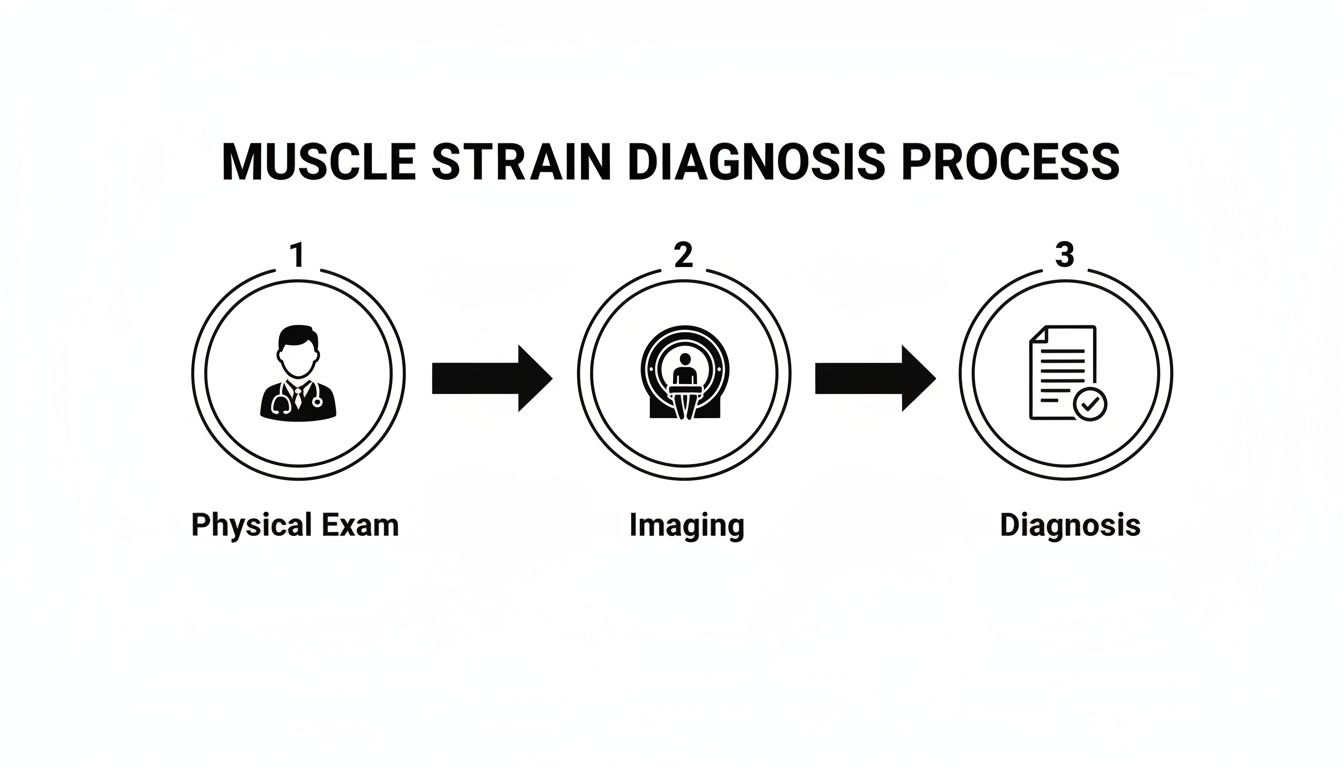
As you can see, it all starts with a physical exam. From there, imaging might be used to get a clearer picture, leading to a precise diagnosis that allows for a realistic and effective recovery plan.
Phase 3: Progressive Return To Activity
The final phase is all about a structured, gradual return to your normal life, ideally guided by a physical therapist. They can build a personalized program that not only strengthens your core but also gets to the root of any weaknesses that might have led to the strain in the first place.
This stage is especially vital for athletes. It’s a big deal in sports, where groin and abdominal injuries can account for 2-5% of all sports-related injuries. For an athlete on the sidelines, getting the right care is crucial for a fast comeback, especially if surgery was involved. In fact, you can see how visiting nurses manage wound care in the community to get a sense of how important post-injury care is.
With 78.1% of these injuries responding well to focused, targeted interventions, a well-managed recovery plan isn't just a good idea—it’s the key to getting back in the game safely and for good.
Strategies to Prevent Future Abdominal Injuries
Once you've fully recovered from an abdominal muscle strain, the last thing you want is a repeat performance. The goal now shifts to prevention, which isn't about doing endless crunches. It's about building a smarter, more resilient core that can handle whatever you throw at it.
Think of it like building a protective shield around your midsection. This shield is forged from a smart mix of flexibility, functional strength, and paying attention to how you move. Nailing these areas is your best bet for significantly lowering the risk of getting hurt again.
First things first: always warm up properly. Cold, stiff muscles are practically begging to be injured. Before you start any workout or strenuous activity, spend a solid 5-10 minutes on dynamic stretching—these are active movements that get your muscles ready for the work ahead.
- Leg Swings: Gently swing your legs forward-and-back and then side-to-side. This is great for waking up your hips and lower core.
- Torso Twists: Stand with your feet about shoulder-width apart and gently rotate your upper body.
- Cat-Cow Stretches: Get on your hands and knees and flow between arching your back up toward the ceiling and then letting it sink down. This mobilizes the spine beautifully.
This isn't just about going through the motions. A good warm-up literally increases blood flow to the muscles and gets your brain and muscles talking to each other again.
Building a Truly Functional Core
After you’re warm, it’s time to build real strength. The most effective prevention comes from exercises that teach your core how to keep your spine stable, not just how to bend it.
Your core's primary job is to resist unwanted movement and transfer power from your legs to your arms. Functional exercises train this exact skill, making your abdomen far less vulnerable to a sudden, awkward strain.
Bring exercises into your routine that build this kind of stability:
- Planks: This is a classic for a reason. It forces your entire core—front, sides, and back—to work as a single, stable unit.
- Bird-Dog: This movement is a fantastic challenge for your balance. It also forces those deep core muscles, like the transversus abdominis, to fire up and stabilize your torso.
- Glute Bridges: Don't forget your glutes! Strong glutes are crucial for supporting your lower back and pelvis, which takes a ton of unnecessary pressure off your abdominal wall.
Finally, get into the habit of using proper body mechanics for everything you do, especially lifting. Before you pick up something heavy, consciously tighten your abs like you're about to take a light punch to the gut. This simple "bracing" technique creates a firm, supportive cylinder around your spine, protecting both it and your abdominal muscles from being overloaded.
Frequently Asked Questions About Abdominal Strains
Dealing with an abdominal muscle strain naturally brings up a lot of questions about what to expect during recovery and what you can and can't do. Let's walk through some of the most common concerns with clear, expert-backed answers.
How Long Does a Pulled Abdominal Muscle Take to Heal?
The healing timeline really comes down to the severity of the injury. A mild Grade 1 strain, which is essentially a minor overstretching of the muscle fibers, usually feels better in about one to three weeks with the right care.
For a more serious Grade 2 strain, where there's a partial tear in the muscle, you're looking at a longer road—typically four to six weeks for a full recovery. The most severe cases are Grade 3 ruptures, which can take several months to heal and, in rare instances, might even require surgery. Sticking to a structured recovery plan is your best bet for healing as efficiently as possible.
Can I Exercise with an Abdominal Strain?
In the beginning, rest is non-negotiable. You have to give the initial inflammation a chance to calm down. Trying to push through the pain is a recipe for making the tear worse and dragging out your recovery time.
After the first couple of days, you can start to reintroduce some very gentle stretches and basic core activation exercises, but only if they are completely pain-free. It's crucial to stop any activity that causes a sharp or stinging feeling—things like crunches, heavy lifting, or running are off the table for a while. A slow, gradual return to your normal routine is the only way to go.
Listen to your body. Any sharp pain is a clear signal that you're pushing too hard. Stop what you're doing immediately and scale back.
How Do I Know if It Is a Strain or a Hernia?
While the pain from a strain and a hernia can feel surprisingly similar at first, there's often one key difference that helps tell them apart. A hernia will frequently create a visible or palpable bulge right under the skin. This lump might pop out or become more obvious when you cough, laugh, or strain to lift something.
An abdominal muscle strain, on the other hand, is a tear within the muscle tissue itself and doesn't usually create that kind of distinct, localized bulge. If you can see or feel a lump, it's really important to get it checked out by a doctor for an accurate diagnosis.
For complex issues that might come up from severe tears or post-surgical complications, you can book a consult with wound care specialists to explore more advanced treatment options.
At Specialty Wound Care, we are dedicated to accelerating the healing process for complex wounds, helping you return to your daily life safely and quickly. Find out more at https://specialtywoundcare.com.