Abdominal Pain Right Side: abdominal pain right side, Causes & Red Flags
That pain on your right side is your body trying to tell you something. It's an incredibly common signal, but it can mean anything from simple indigestion to a serious emergency like appendicitis. The first clue to figuring it out is simple: where, exactly, does it hurt? Is it higher up or lower down?
Understanding Your Abdomen's Geography
Think of your abdomen as a map divided into four quadrants. When you’re dealing with pain on the right side, a doctor immediately zeroes in on two of these zones: the upper right quadrant and the lower right quadrant. Each area houses a different set of organs, and knowing what lives where is the first step in decoding the pain’s message.
This simple geographical approach helps turn vague worry into a clear understanding of why location is so critical for diagnosis.
The Upper Right Quadrant
Your upper right quadrant, tucked just below your right ribs, is some seriously important real estate. The main residents here are:
- The Liver: Your body's biggest internal organ, constantly filtering blood and making bile.
- The Gallbladder: A small sac nestled under the liver that stores that bile.
- The Pancreas: A gland sitting behind your stomach, with its "head" reaching into this quadrant.
- Parts of the Small Intestine and Colon: Sections of your digestive tract are also passing through.
Pain that starts here is very often linked to the liver or gallbladder—think gallstones or inflammation.
The Lower Right Quadrant
Moving down, the lower right quadrant is another hot spot for diagnostic clues. This neighborhood contains:
- The Appendix: That small, finger-shaped pouch connected to your large intestine.
- The Ascending Colon: The first section of the large intestine.
- Portions of the Small Intestine: The final parts of the small bowel.
- The Right Ovary and Fallopian Tube (in women): Key reproductive organs.
- The Right Ureter: The tube carrying urine from your right kidney.
This is the area famous for appendicitis pain, but it can also flag problems with the ovaries, intestines, or even a kidney stone on the move.
The map below helps visualize which organs are in the upper versus the lower right side.
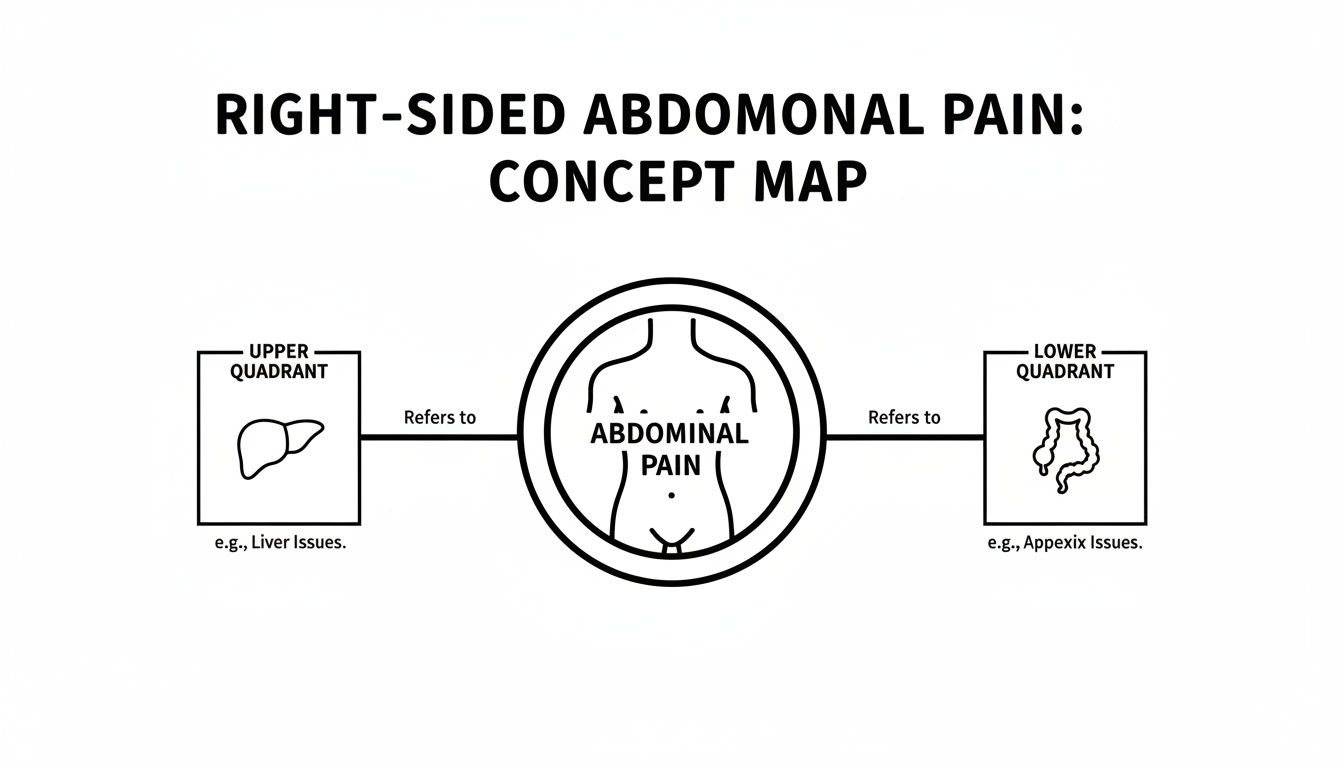
This visual really drives home how quickly location helps narrow down the possibilities, pointing toward the liver and gallbladder up top or the appendix down below.
Here's a quick reference table to help you connect the dots between where you feel the pain and what might be going on inside.
Quick Guide to Right-Sided Pain Locations and Potential Sources
| Pain Location Quadrant | Key Organs in This Area | Common Causes of Pain |
|---|---|---|
| Upper Right Quadrant | Liver, Gallbladder, Pancreas, Duodenum | Gallstones, Hepatitis, Liver Abscess, Pancreatitis |
| Lower Right Quadrant | Appendix, Ascending Colon, Right Ovary | Appendicitis, Ovarian Cysts, Hernia, Kidney Stones, IBD |
This isn't for self-diagnosis, of course, but it gives you a starting point for understanding what your healthcare provider is thinking about when they ask, "Where does it hurt?"
The number of people dealing with these issues is staggering. Pain on the right side of the abdomen is a major factor in nearly 10% of all emergency room visits around the world.
And appendicitis, the classic cause of sharp lower right abdominal pain, isn't rare—it affects about 7% of people in the U.S. during their lifetime, leading to over 250,000 hospitalizations every year in the States alone. You can dive deeper into the causes and treatments for right-sided abdominal pain to get a more complete picture.
Pain in Your Upper Right Abdomen Explained
When pain decides to set up camp on your right side, just under your ribs, it's usually pointing to a specific neighborhood of organs. This area, the upper right quadrant, is prime real estate for your liver, gallbladder, and parts of your pancreas and intestines. Any discomfort here is like a flashing light on your body's dashboard, often signaling trouble with the gallbladder or liver.
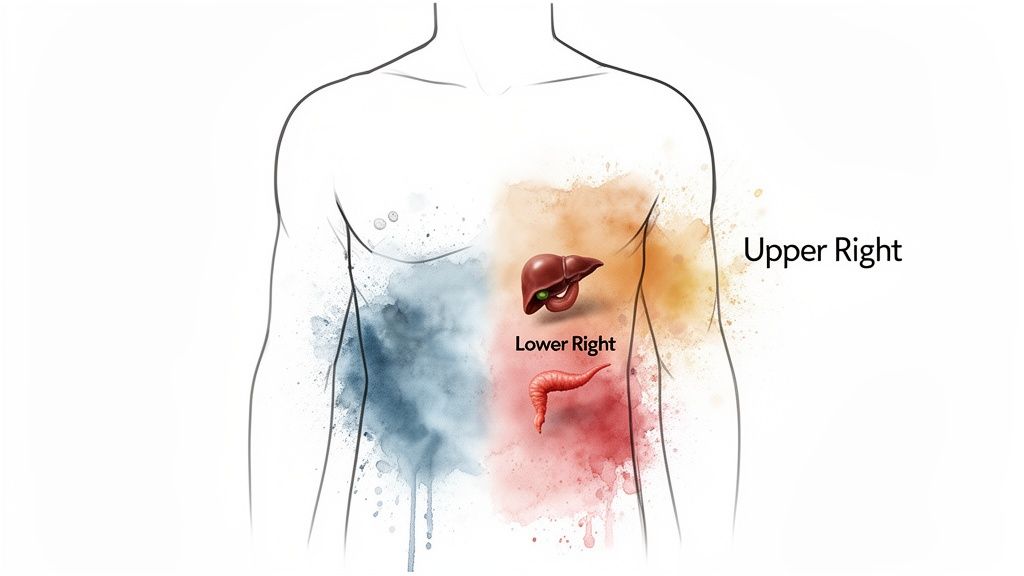
Learning to recognize the signature pain patterns of each organ is the first step toward figuring out what your body is trying to tell you. Of course, this doesn't replace a doctor's visit, but understanding these signals helps you give a much clearer picture of what's going on.
The Gallbladder: Common but Intense Pain
Your gallbladder is a small, pear-shaped organ tucked beneath the liver. Its main job is to store bile, a fluid your liver makes to help digest fats. Think of it as a small reservoir. The trouble often starts when you eat a fatty meal, and the gallbladder contracts to release that bile into your small intestine.
The most common culprit here is gallstones—hard, pebble-like deposits that form inside the gallbladder. They can be as tiny as a grain of sand or as large as a golf ball. Many people have them and never know it, but if they move and block a bile duct, the pain can be absolutely excruciating.
Gallstone-related pain, known as biliary colic, often feels like a sudden, intense ambush. It's a sharp, cramping, or gnawing pain that can stick around for 30 minutes to several hours.
This kind of pain is notorious for showing up after a heavy or greasy meal, often hitting in the evening or waking you up at night. The pain can be so severe it literally takes your breath away, and it might even radiate to your right shoulder or between your shoulder blades.
If a gallstone creates a stubborn blockage, it can lead to cholecystitis, which is just a fancy term for gallbladder inflammation. This is a more serious situation, bringing on a more constant, severe pain that's often joined by:
- Fever and chills
- Nausea and vomiting
- Tenderness when you press on your upper right abdomen
The Liver: A Source of Dull, Aching Pain
The liver is a large and remarkably resilient organ, but it's not immune to problems. Unlike the sharp, sudden attacks from the gallbladder, pain coming from the liver is usually described as a dull, persistent ache or a feeling of fullness in that upper right area.
Several conditions can cause the liver to become inflamed and sore. Hepatitis, which simply means inflammation of the liver, is a major one. This can be caused by viral infections (like Hepatitis A, B, or C), drinking too much alcohol, or other underlying health issues.
Another increasingly common problem is fatty liver disease, where too much fat builds up in the liver cells. It's often silent in the early stages, but as it progresses, it can cause inflammation and that tell-tale nagging ache on your right side.
The Pancreas: An Overlapping Concern
While the pancreas is located more in the center of your abdomen, behind the stomach, its "head" actually reaches into the upper right quadrant. When the pancreas becomes inflamed—a condition called pancreatitis—it can cause severe upper abdominal pain that often radiates straight through to your back.
So, while the pain is technically more central, it's very common for people to perceive it as right-sided pain. This pain is usually constant, severe, and tends to get worse after eating or when you're lying down flat. Interestingly, gallstones are one of the leading causes of acute pancreatitis, creating a direct link between gallbladder and pancreas problems.
Getting to the Bottom of Lower Right Abdomen Pain
While the upper abdomen has its own common culprits, the lower right quadrant is a real diagnostic hotspot, notorious for causing intense and often urgent problems. When pain strikes this area, you need to pay close attention. It’s home to the appendix, parts of your colon, and crucial reproductive organs, so understanding what might be going on can help you figure out when a simple twinge has turned into a true emergency.
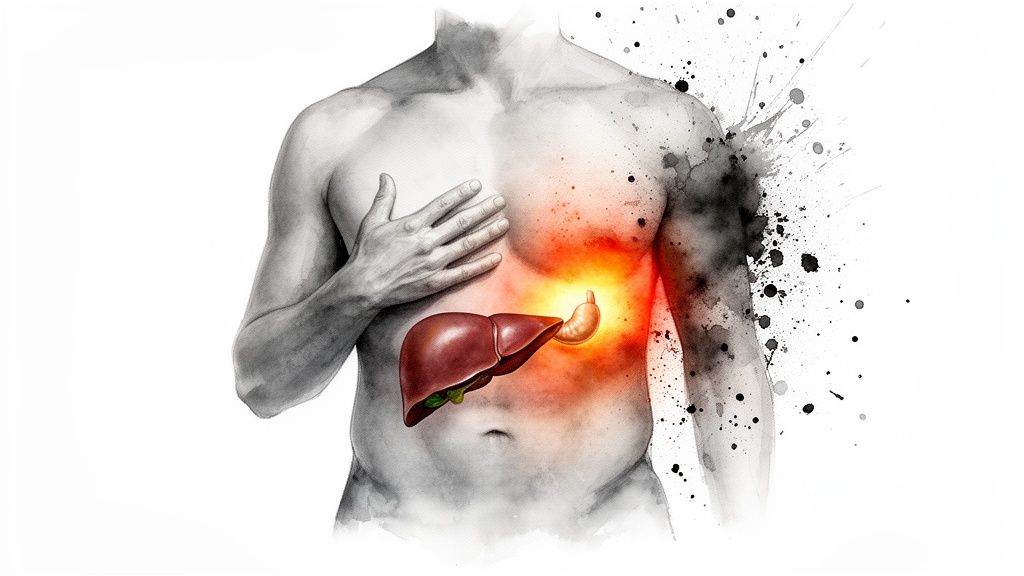
The complexity of this area is exactly why abdominal pain right side is a massive driver for healthcare visits. In the US, it's one of the top symptoms that sends people to GI outpatient appointments and is a regular feature in the ER. Globally, conditions like appendicitis are a leading reason for hospital stays, which just goes to show how often this specific pain is a sign of something serious. If you're interested in the numbers, you can dig deeper into the epidemiology of abdominal pain to see its widespread impact.
Appendicitis: The Most Famous Culprit
When you hear "pain in lower right abdomen," appendicitis is probably the first thing that pops into your head—and for good reason. It’s one of the most common causes of emergency abdominal surgery. The whole thing kicks off when the appendix, a small finger-shaped pouch hanging off the large intestine, gets inflamed and fills with pus.
The pain from appendicitis follows a classic, almost textbook progression. It usually starts as a dull, vague ache right around your belly button. But over the next few hours, that discomfort gets sharper and starts to move, settling into a constant, intense pain in the lower right quadrant.
Clinicians often pinpoint appendicitis pain at a spot known as McBurney's point—located about two-thirds of the way from your navel to the bony bump on your right hip. Just pressing on this area can cause significant tenderness.
A few other symptoms usually tag along, creating a pretty clear clinical picture:
- A low-grade fever that might get worse as the inflammation ramps up
- Nausea and even vomiting
- A complete loss of appetite
- Feeling bloated or constipated
If you ignore it, an inflamed appendix can actually burst. That’s a life-threatening complication that spreads infection all through the abdomen. This is why any worsening lower right abdominal pain is a signal to see a medical professional right away.
Other Potential Causes in the Lower Right Quadrant
While appendicitis gets all the headlines, it’s far from the only show in town. A few other conditions can cause similar symptoms down there, making a professional diagnosis absolutely critical.
Kidney Stones
When a kidney stone decides to make a run for it from the right kidney down the ureter, it can cause excruciating, sharp pain. People often describe this pain as "colicky," meaning it comes in intense waves and can even radiate down to the groin. It’s typically joined by other tell-tale signs like painful urination, seeing blood in your urine, or feeling a constant, urgent need to go.
Hernias
An inguinal hernia happens when tissue, like a piece of the intestine, pushes through a weak spot in your abdominal muscles. This can create a noticeable bulge in the groin or scrotum and cause anything from a dull ache to a sharp pain, especially when you cough, bend over, or lift something heavy.
Gender-Specific Causes of Lower Right Abdominal Pain
Because the lower right quadrant also houses key reproductive organs, some causes of pain are specific to a person's biology.
For women, several gynecological issues can create pain that feels a lot like appendicitis:
- Ovarian Cysts: A ruptured cyst on the right ovary can trigger sudden, severe, and sharp pain.
- Ovarian Torsion: This is a true medical emergency where the ovary twists on itself, cutting off its blood supply and causing intense pain.
- Ectopic Pregnancy: When a pregnancy implants outside the uterus (usually in a fallopian tube), it can cause sharp pain and is another life-threatening condition.
For men, a condition called testicular torsion can cause severe pain that starts in the testicle and radiates up into the lower abdomen. Just like ovarian torsion, this is an emergency that needs immediate surgery to save the testicle. This wide array of possibilities is exactly why trying to self-diagnose abdominal pain right side is a bad idea—the stakes are just too high.
When Digestive Issues Are the Real Culprit
Not all right-sided abdominal pain screams for an emergency room visit. Sometimes, the problem isn’t a single, inflamed organ like the appendix or gallbladder. Instead, the discomfort comes from the way your whole digestive system is working—or not working—at the moment.
Think of it this way: conditions like simple indigestion, trapped gas, or Irritable Bowel Syndrome (IBS) can all throw a wrench in the works, causing very real pain that just happens to show up on your right side.
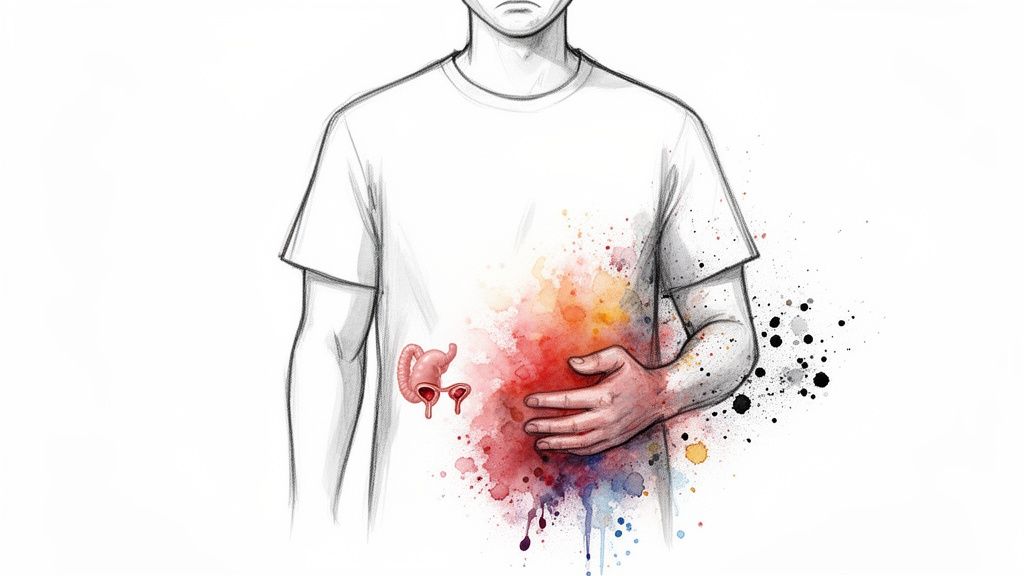
Your large intestine, or colon, is a long and winding road. On the right side, right up near your liver, it takes a sharp turn known as the hepatic flexure. It's a bit like a tight corner on a highway, and it’s a classic spot for gas to get stuck. When that happens, it can cause sharp, stabbing pains that feel incredibly alarming, easily mimicking a gallbladder attack.
Similarly, a simple case of indigestion after eating too fast or indulging in greasy food can cause a dull, burning ache anywhere in your upper abdomen, including the right side. While it’s no fun, this kind of pain is usually short-lived and goes away on its own.
Irritable Bowel Syndrome: A Common Impersonator
Then there's Irritable Bowel Syndrome (IBS), a functional gut disorder. This means that even though your digestive system looks perfectly normal on scans, it just doesn't function correctly. IBS is really a collection of symptoms: cramping, bloating, gas, and unpredictable bowel habits like diarrhea, constipation, or a frustrating mix of both.
The pain from IBS often comes from intense muscle spasms in the colon. These spasms are unpredictable and can be quite severe. When they hit the right side of your colon, the pain can be sharp enough to make you worry something is seriously wrong.
Unlike the steady, escalating pain of appendicitis, IBS pain tends to be chronic. It follows a frustrating pattern of flaring up for a while before settling back down. Stress, certain foods, and even hormonal changes can all be triggers. This is why keeping a symptom and food diary is often the first and most powerful step toward figuring out your personal triggers and getting some relief.
Telling Functional Pain Apart From a True Emergency
So, how do you know if you're dealing with a manageable issue like IBS or a genuine medical emergency? The key is to look at the whole clinical picture, not just the pain itself.
- The Pain Pattern: Has this pain been coming and going for weeks or months? That points more toward IBS. Is it a brand-new, severe pain that's getting worse by the hour? That’s a potential red flag for something like appendicitis.
- What Helps (or Doesn't): Pain from gas or IBS often gets better after you have a bowel movement or pass gas. The pain from a true emergency won't be relieved by either.
- The Red Flags: Watch out for "red flag" symptoms. A high fever, constant vomiting, a hard or rigid abdomen, or pain so bad you can't find any relief are all clear signals that you need to get medical help right away.
It's important to remember that general digestive discomfort is incredibly common. One massive global study found that 51.9% of adults experienced abdominal pain in the last three months, with many cases linked directly to eating—a common trigger for both gallstones and IBS. The research, detailed in the full Rome Foundation global study, also noted that frequent meal-related pain was more common in younger people and women, showing how these functional disorders can affect different groups.
While this kind of functional pain isn’t life-threatening, it can absolutely torpedo your quality of life. The bottom line is to work with your healthcare provider to get a solid diagnosis, rule out anything more serious, and build a management plan that actually works for you.
Red Flag Symptoms You Should Never Ignore
Most of the time, a pain on your right side is just a temporary nuisance. But sometimes, it's your body's version of a blaring fire alarm. Learning to spot these "red flag" symptoms isn't just a good idea—it can be life-saving. Think of them less as suggestions and more as direct orders to get medical help, fast.
The key is to quickly figure out if you're dealing with simple discomfort or a genuine crisis. When that pain is joined by other severe symptoms, the "wait and see" approach is off the table. Getting a fast, accurate diagnosis becomes the top priority.
When to Go to the Emergency Room
If your right-sided abdominal pain comes with any of the following, it's time to head to the nearest emergency room or urgent care center. For anyone experiencing these kinds of severe symptoms, a local Burton urgent care provider can offer immediate help. Don't hesitate if you notice:
-
Unbearable Pain: We're talking about pain so bad you can't stand up straight, get comfortable, or even think clearly. This is a massive warning sign that could point to a serious problem like a ruptured appendix or a blocked bile duct.
-
High Fever with Pain: A fever climbing above 100.4°F (38°C) alongside the pain is a classic sign of a significant infection. This could be anything from appendicitis to cholecystitis (gallbladder inflammation) or a nasty kidney infection.
-
Persistent Vomiting: Feeling a bit nauseous is one thing, but if you can't keep any food or even liquids down for hours, that's a major red flag. This can quickly lead to severe dehydration and might indicate an intestinal blockage.
A rigid, hard, or "board-like" abdomen is a critical sign of peritonitis—a dangerous inflammation of the abdominal lining. This is often caused by a ruptured organ and is a life-threatening medical emergency that needs immediate surgery.
Other Critical Warning Signs
Beyond those common red flags, a few other symptoms are just as urgent. These can signal internal bleeding, a widespread infection, or other system-wide problems that need immediate medical attention to stabilize.
Stay on high alert for:
- Signs of Shock: Feeling dizzy, faint, or confused? Is your heart racing while your skin is pale and clammy? These are all signs your body is in distress and struggling to cope.
- Noticeable Abdominal Swelling: If your abdomen is swelling up quickly or feels unusually distended, it could mean a dangerous buildup of fluid or internal bleeding. In some cases, severe underlying conditions can lead to issues like ascites, a complication often linked to pancreatic cancer, where fluid fills the abdominal cavity.
- Changes in Skin Color: If you notice a yellow tint to your skin or the whites of your eyes (jaundice), it's a clear signal of a serious problem with your liver or gallbladder.
The bottom line is simple: trust your gut. If the pain feels severe, keeps getting worse, or shows up with any of these red flag symptoms, it's always better to be safe than sorry. Seek professional medical care right away.
What to Expect When You See a Doctor
Walking into a clinic with a mysterious pain in your side can feel pretty overwhelming. But knowing what the doctor is looking for can take a lot of the stress out of the visit. Think of your doctor as a detective trying to solve the case of your abdominal pain right side. The whole process is really just a methodical investigation, and it all starts with the most important clue: you.
You're the one experiencing the symptoms, so you're the best source of information. The more details you can provide about what you're feeling, the faster your doctor can start to connect the dots and figure out what’s going on.
The Medical History and Initial Questions
First things first, your doctor is going to have a conversation with you. This isn't just friendly chatter; every question is designed to build a profile of your pain.
They'll likely ask about a few key things:
- Pain Characteristics: When did this all start? Is it a sharp, stabbing pain, or more of a dull, constant ache? Does it seem to come and go in waves?
- Location and Radiation: Can you point with one finger to the exact spot where it hurts most? Does that pain seem to travel anywhere else, like into your back or up to your shoulder?
- Triggers and Relievers: What makes it better or worse? Does eating a big, fatty meal set it off? Does lying down, walking around, or passing gas seem to help?
- Associated Symptoms: Besides the pain, are you dealing with anything else? Think fever, nausea, vomiting, diarrhea, or any changes when you urinate.
Giving clear answers here is huge. For example, if you mention the pain started vaguely around your belly button and then shifted down to your lower right side, that’s a classic story that immediately makes a doctor think about appendicitis.
The Physical Examination
After getting your story, your doctor will need to do a physical exam. This hands-on step is all about confirming suspicions and pinpointing the trouble spot.
They'll probably start by just looking at your abdomen and listening with a stethoscope to check on your bowel sounds. Then comes palpation, which is just a fancy word for gently pressing on different parts of your belly. They’re feeling for any tenderness, rigidity, or swelling and trying to map out exactly where it hurts. This helps them figure out if the pain lines up with a specific organ, like the gallbladder in your upper right abdomen or the appendix down low.
This part of the exam is crucial. Your doctor might check for "rebound tenderness"—where it hurts more when they quickly let go after pressing down. That's a classic sign that the lining of your abdomen is inflamed, which often points to a more urgent problem.
Ordering Diagnostic Tests
Sometimes, your story and the physical exam are enough. But often, your doctor will need a bit more evidence to be certain. That's where diagnostic tests come into play. They aren't just ordered at random; each test is chosen to answer a specific question. If your doctor thinks you need a closer look, they'll explain what they're recommending. You can also learn more about various types of medical testing to get a better idea of what's involved.
Common tests for right-sided pain include:
- Blood Tests: A complete blood count (CBC) can show a high white blood cell count. That’s a major clue for an infection, which is common with things like appendicitis or cholecystitis.
- Urine Tests: A quick urinalysis can spot signs of a urinary tract infection or kidney stones, both of which can cause pain on your right side.
- Imaging Scans: This is where doctors get a direct look inside. An ultrasound or a CT scan can actually show them things like gallstones, an inflamed appendix, or an ovarian cyst.
By putting all these pieces together—your story, the exam, and the test results—your provider can solve the puzzle and get you on the right treatment plan. If you're dealing with symptoms that have you worried and you're not sure what to do next, you can always book a consult to talk things over with a healthcare professional.
Common Questions About Right-Sided Abdominal Pain
When you’re dealing with pain on the right side of your abdomen, it's natural to have a lot of questions. Below, we've answered some of the most common ones we hear, giving you straightforward answers to help you understand what might be going on.
Can Gas Cause Sharp Pain on My Right Side?
Yes, it absolutely can. It might be surprising, but trapped gas can cause incredibly sharp, stabbing pains anywhere in your belly, and the right side is a common spot.
This pain often feels like it's on the move, and you might get some relief after passing gas. Bloating is another classic sign that usually comes along with it. While it feels awful, gas pain typically isn’t accompanied by more serious symptoms like a high fever or vomiting that just won't stop.
But if the pain is severe, constant, and simply isn't getting better, it’s time to get it checked out. A doctor needs to rule out other, more serious causes of your abdominal pain right side.
How Can I Tell Appendicitis from Ovarian Cyst Pain?
This is a really tough one, and it’s a question we get all the time. Both conditions hit the lower right abdomen and can feel surprisingly similar at first. The real clues are in how the pain starts and what other symptoms pop up.
Appendicitis Pain:
- The Journey: It often starts as a dull, annoying ache right around your belly button before it migrates to the lower right side.
- The Feeling: The pain becomes constant and sharp, getting steadily worse over a matter of hours. You can often point to the exact spot.
- The Sidekicks: It usually brings friends—namely, a loss of appetite, nausea, and a low-grade fever.
Ovarian Cyst Pain:
- The Journey: Pain from a ruptured cyst is often a sudden, sharp jolt that’s intense right from the start.
- The Feeling: It can be very sharp and localized, but sometimes it’s more of a dull, persistent ache, depending on what's happening with the cyst.
- The Sidekicks: It might happen around the middle of your menstrual cycle and often doesn't come with a fever unless an infection has set in.
Because the symptoms can overlap so much, any severe pain in your lower right abdomen needs a professional medical evaluation. This isn't something you should ever try to diagnose on your own.
What Home Remedies Are Safe for Mild Abdominal Pain?
For mild pain that you're pretty sure is just from indigestion or gas, a few simple things can help bring relief.
Try resting in a comfortable position and applying a warm compress or hot water bottle to your abdomen. Sipping on clear fluids like water or peppermint tea can also be very soothing. It's a good idea to hold off on solid food for a few hours to give your digestive system a break.
Here’s a critical piece of advice: avoid taking pain medications like ibuprofen (NSAIDs) or aspirin. These can irritate the stomach and could make things like gastritis or an ulcer much worse.
If the pain doesn't ease up within a few hours or starts to get worse, that's your cue to stop self-treating and call a healthcare provider. For more general questions about medical care, our list of frequently asked questions has some great information.
At Specialty Wound Care, we are dedicated to providing advanced solutions and clear guidance for complex health issues. We believe informed patients are empowered to make the best decisions for their well-being. https://specialtywoundcare.com