Pressure ulcer treatment guidelines: Evidence-based wound care
Effective pressure ulcer treatment guidelines are the bedrock of modern wound care. They give us a systematic, evidence-based roadmap to prevent, assess, and manage these incredibly complex wounds. By establishing best practices for everything from staging and debridement to nutrition and offloading, they standardize care. This ensures every patient receives high-quality, consistent treatment rooted in proven clinical outcomes.
Why Modern Pressure Ulcer Guidelines Matter
Imagine trying to build a house without a blueprint. You might have the right materials—dressings, support surfaces, and skilled staff—but the process would be chaotic, inconsistent, and probably doomed to fail. Modern pressure ulcer treatment guidelines are that essential blueprint for wound care.
These protocols aren’t just arbitrary rules. They represent the culmination of decades of hands-on clinical experience and hard-nosed scientific research. They create a common language and a standardized playbook, making sure every patient benefits from the most effective strategies known to medicine. That consistency is what truly moves the needle on improving patient outcomes.
The Evolution from Description to Evidence
In the early days, our approach was often descriptive and reactive. We saw a wound, we described it, we reacted. Today, the focus has flipped to a proactive, evidence-based model that reflects a much deeper understanding of wound physiology and the roadblocks to healing.
These guidelines have been refined over decades, moving from simple descriptive staging to comprehensive, multidisciplinary protocols. Now, the emphasis is squarely on risk assessment, prevention, and standardized measurement. A pivotal moment came in 2016 when the National Pressure Ulcer Advisory Panel (NPUAP), founded in 1987, updated its terminology. "Pressure ulcer" officially became "pressure injury" to better capture the full scope of underlying tissue damage, not just what's visible on the surface.
This solid, evidence-based foundation is what gives the guidelines their power. To really appreciate the science behind these protocols, it helps to know how to effectively read scientific papers and pull out the key clinical data.
Creating a Standard of Care
Ultimately, these guidelines establish a clear standard of care that protects both patients and clinicians. For patients, it means receiving care that is validated and effective, slashing the risk of devastating complications like infection and amputation.
For clinicians, it provides a defensible framework for decision-making, aligning their practice with nationally recognized best practices. Adhering to these guidelines is a core part of providing great collaborative care, no matter the setting. You can learn more about the goals of advanced home wound collaborative care in our related article. This systematic approach ensures that every step we take is purposeful and laser-focused on one thing: healing the wound.
Mastering Pressure Injury Staging and Assessment
Getting the staging right is the absolute foundation of any effective pressure ulcer treatment plan. Think of it as the GPS for wound healing—without knowing your exact starting point, you can’t map out the quickest, most direct route to recovery. This initial assessment isn't just about sticking a label on a wound; it’s about truly understanding its depth and severity so you can pick the right interventions from day one.
Treating a Stage 1 injury on intact skin is worlds apart from managing a Stage 4 that goes down to muscle or bone. When we nail the staging, we ensure the treatment plan is appropriate, stop the wound from getting worse, and set realistic goals for healing.
This visual shows how a commitment to evidence-based care is the bedrock for both assessment and prevention.
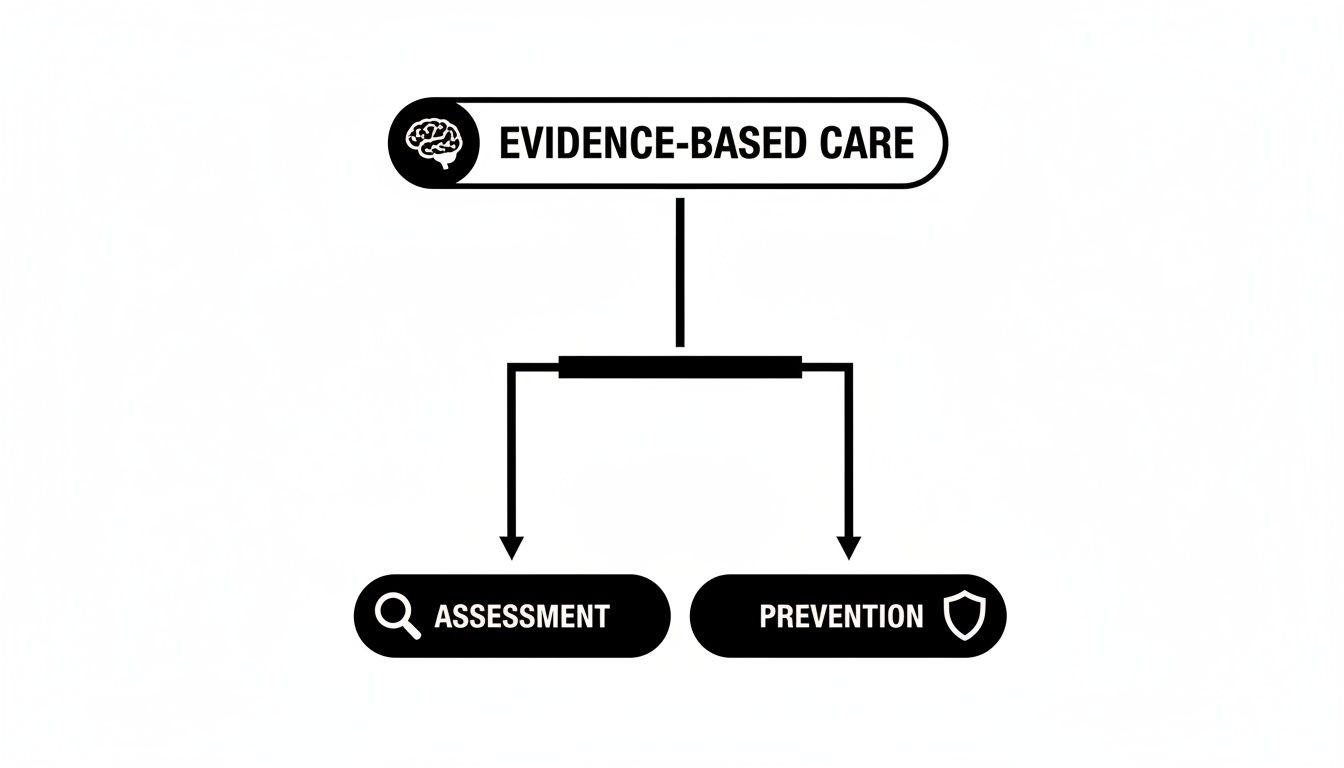
Simply put, a solid, evidence-based approach sharpens our ability to evaluate existing injuries and, just as importantly, to prevent new ones from ever forming.
Understanding the Stages of Pressure Injuries
To make sure everyone is speaking the same language, the National Pressure Injury Advisory Panel (NPIAP) created a standardized staging system. This system classifies injuries based on how much tissue damage we can see.
For a quick reference, this table breaks down the key characteristics of each stage, making it easier to identify them in a clinical setting.
Pressure Injury Staging at a Glance
| Stage | Key Characteristics | Clinical Appearance |
|---|---|---|
| Stage 1 | Non-blanchable erythema of intact skin. | Persistent redness that doesn't turn white when pressed. In darker skin, it may appear as a different color (purple/maroon) than surrounding skin. Area may be painful, firm, or have a different temperature. |
| Stage 2 | Partial-thickness skin loss with exposed dermis. | A shallow, open ulcer with a red-pink wound bed. It might also look like an intact or ruptured serum-filled blister. No slough is visible. |
| Stage 3 | Full-thickness skin loss. | Deeper than Stage 2, with visible adipose (fat) tissue. Slough may be present, but you can still see the depth of the wound. Muscle, tendon, and bone are not exposed. |
| Stage 4 | Full-thickness skin and tissue loss. | The most severe stage. Muscle, tendon, ligament, cartilage, or even bone is directly visible. Slough or eschar may be present. |
| Unstageable | Obscured full-thickness skin and tissue loss. | The wound bed is completely covered by slough (yellow, tan, gray) or eschar (tan, brown, black). The true depth—and therefore the stage—can't be determined until the covering is removed. |
| Deep Tissue Pressure Injury (DTPI) | Persistent non-blanchable deep red, maroon, or purple discoloration. | Appears as a deep bruise under intact skin or as a blood-filled blister. This injury happens from intense pressure deep at the bone-muscle interface. It can evolve rapidly. |
As you can see, the stages give us a clear, progressive picture of tissue damage. The ability to distinguish between a DTPI and a Stage 1, for example, is critical because their underlying pathology and potential for deterioration are vastly different.
Beyond Staging: A Comprehensive Wound Assessment
Correct staging is the first step, not the last. To build a truly effective treatment strategy, we need to perform a complete assessment that paints the full clinical picture. This means looking closely at the wound itself and the skin around it.
A thorough assessment should always include these key components:
- Wound Dimensions: Accurately measure the length, width, and depth. Tracking these numbers over time is how we know if our plan is working.
- Tissue Types: Document the percentage of different tissues in the wound bed—is it healthy red granulation tissue, or is it covered in yellow slough or black eschar?
- Exudate Amount and Type: Note the volume of drainage (scant, moderate, copious) and its character (clear serous, bloody sanguineous, or pus-like purulent).
- Periwound Skin: Examine the skin around the ulcer. Is it macerated from moisture? Is there spreading redness (erythema) suggesting infection?
The Role of Advanced Diagnostic Imaging
While a trained eye is our most fundamental tool, some problems hide beneath the surface. Advanced diagnostics can give us a look at what the naked eye can't see, like high bacterial loads that stall the healing process.
Fluorescence imaging, for instance, is a non-invasive technology that lights up bacteria in real time. This allows for incredibly targeted debridement and sampling, making sure we’re treating the problem area directly. You can see exactly how a point-of-care wound imaging device detects bacteria to guide treatment decisions.
When we combine our classic assessment skills with modern technology, we can make more informed decisions, which ultimately leads to better, faster healing for our patients.
Applying the TIME Framework for Wound Bed Preparation
Once you've staged and assessed a pressure ulcer, the real work begins: preparing the wound bed for healing. I always tell new clinicians to think of the wound bed like a garden plot. You can’t expect healthy tissue to grow if the soil is packed with weeds, rocks, and debris. This is where the TIME framework comes in as an indispensable tool, guiding our approach to modern pressure ulcer treatment.
The acronym TIME stands for Tissue, Infection/Inflammation, Moisture, and Edge. It's more than just a memory aid; it's a clinical checklist that forces us to tackle the four biggest local barriers that can stall—or completely stop—the healing process. By methodically working through each part, we create the perfect environment for the body's natural healing powers to take over.
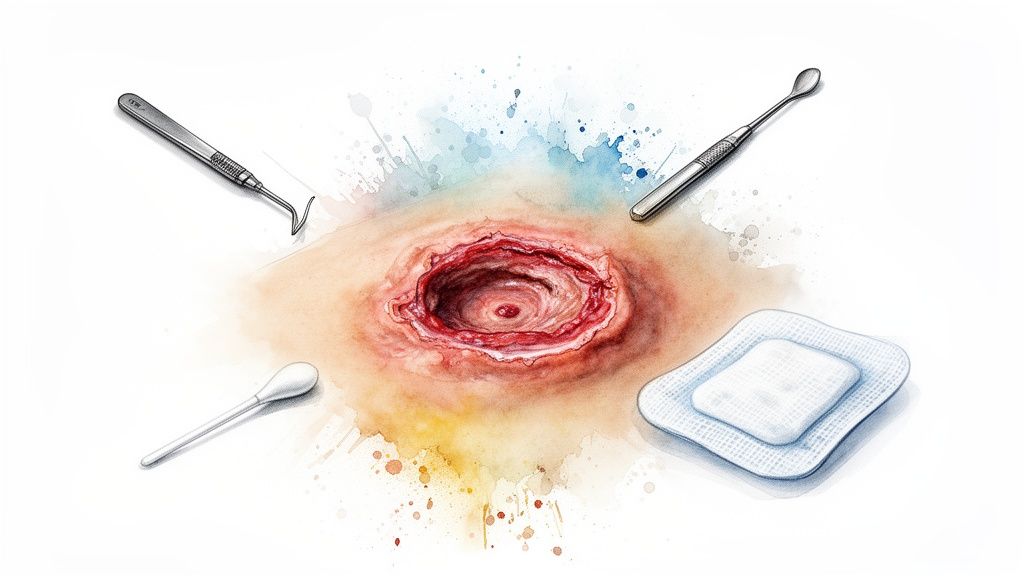
This structured method shifts wound care from a reactive guessing game to a proactive, evidence-based strategy, ensuring we don't miss a single crucial step.
T is for Tissue Management
The "T" in TIME is all about Tissue management, which means removing non-viable or dead tissue. We call this process debridement. Dead tissue, whether it's yellowish slough or black, leathery eschar, is a major roadblock. It physically blocks healthy granulation tissue from forming and acts as a buffet for bacteria, dramatically increasing the risk of infection.
We have several debridement methods in our toolkit, and the right choice depends on the wound, the patient's overall condition, and the clinical setting.
- Surgical/Sharp Debridement: This is the fastest method, using a scalpel or scissors to precisely cut away non-viable tissue. It's our go-to for wounds with extensive necrotic tissue or signs of a rapidly advancing infection.
- Enzymatic Debridement: This involves applying a topical agent with enzymes that selectively break down dead tissue while leaving healthy cells alone.
- Autolytic Debridement: Here, we leverage the body's own enzymes to liquefy the dead tissue. It's a slower, more selective process that we encourage by using moisture-retentive dressings.
- Mechanical Debridement: Older methods like wet-to-dry dressings fall into this category. They're used much less frequently now because they can be non-selective and accidentally tear away healthy new cells along with the bad stuff.
Clearing out this dead tissue is the absolute, non-negotiable first step. Without it, you're not going to get far.
I is for Infection and Inflammation
Next up, the "I" focuses on managing Infection and Inflammation. A key thing to remember is that all chronic wounds have bacteria on them, but that doesn't mean they're all infected. Our goal is to manage the bacterial load, or bioburden, so it doesn't overwhelm the patient’s immune system and kick off a destructive inflammatory response.
A core principle in pressure ulcer treatment is telling the difference between bacterial colonization (where bacteria are present but not causing harm) and critical colonization or outright infection (where their presence is delaying healing and causing a reaction).
In chronic wounds, the classic signs of infection like fever might be absent. Instead, we have to look for more subtle clues: a sudden increase in pain, a change in the color or smell of the exudate, or a wound that simply stops making progress. These are the red flags. If we suspect an infection, we'll turn to antimicrobial dressings or, in more serious cases, systemic antibiotics, ideally guided by diagnostic tests.
M is for Moisture Balance
"M" stands for Moisture balance. Wounds need moisture to heal—it helps cells move around and get their work done. But it’s a delicate balance. Too much moisture, and the skin around the wound gets soggy and breaks down (a process called maceration). Too little, and the wound bed dries out, forming a hard scab that stops healing in its tracks.
Getting this balance right is truly an art. It’s all about picking the right dressing for the job. We need to decide if the wound needs a dressing that can donate moisture to a dry bed or one that can soak up excess fluid from a weeping wound. This is exactly why a one-size-fits-all approach to dressings is doomed to fail; the dressing choice has to match what the wound needs right now.
E is for Edge of the Wound
Finally, "E" represents the Edge of the wound, where we focus on epithelial advancement. For a wound to finally close, new skin cells have to migrate from the edges across the healthy, prepared wound bed. But if those edges are rolled under (epibole), dried out, or just plain unhealthy, that migration process grinds to a halt.
Managing the wound edge effectively often comes down to making sure the other three steps—debridement, infection control, and moisture balance—have been handled correctly. Sometimes, even with perfect preparation, the edges remain stubborn. In these cases, we might need to bring in advanced therapies to kickstart the healing cascade and finally get that wound to close.
Selecting the Right Dressings and Advanced Therapies
Once the wound bed is clean and ready, the next step in pressure ulcer treatment is picking the right dressing. Don't think of dressings as just simple covers; they are active tools we use to create the perfect healing environment. The sheer number of options can feel overwhelming, but it all gets simpler when you ask one key question: What does this specific wound need right now?
Getting the dressing right is all about moisture balance. The goal is to hit that sweet spot—not too dry, which stops healthy cells from moving in, and not too wet, which can macerate and damage the surrounding skin.
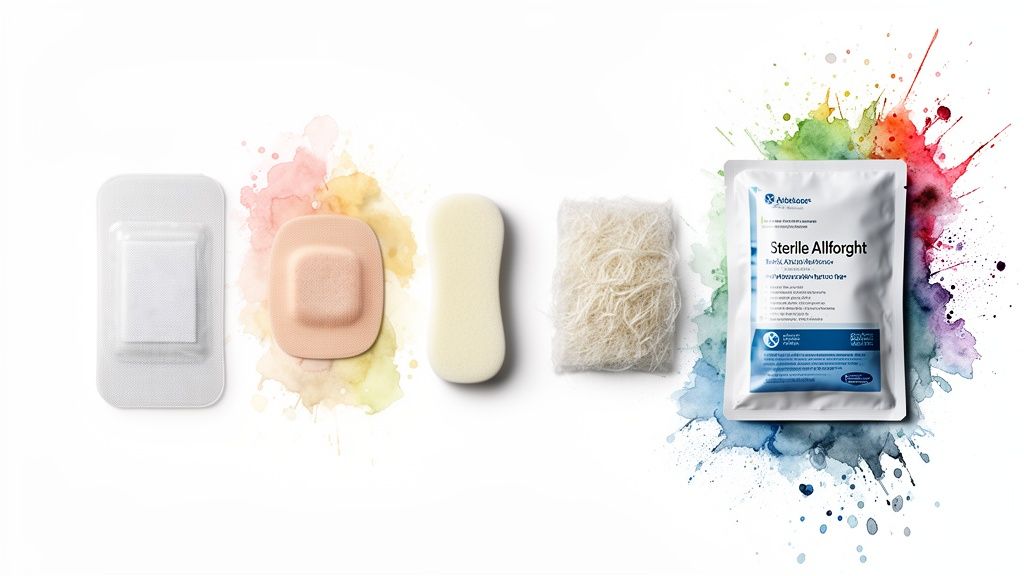
Matching Dressing Types to Wound Needs
Different dressings have different superpowers. Some are built to soak up a ton of fluid, while others are designed to add moisture. Here’s a quick rundown of common types and what they’re best for:
- Transparent Films: These thin, see-through dressings are perfect for protecting Stage 1 injuries or covering shallow wounds that have very little drainage. They lock in moisture but aren't absorbent.
- Hydrocolloids: These contain gel-forming agents that create a moist environment, which is ideal for helping the body’s own enzymes break down dead tissue (autolytic debridement). They work best for wounds with light to moderate drainage.
- Foams: These are the real workhorses for absorption. Foam dressings are fantastic for managing moderate to heavy drainage, pulling that excess fluid away from the wound to keep the surrounding skin healthy.
- Alginates and Hydrofibers: Made from seaweed (alginates) or super-absorbent fibers, these are the champions of absorption. They turn into a gel as they soak up heavy drainage, making them the go-to for deep or heavily draining wounds.
The key here is to keep reassessing. A wound that needs a heavy-duty alginate today might be ready for a simple foam dressing next week as it heals and drainage lessens.
When Standard Care Is Not Enough
Sometimes, even with the best wound prep and the perfect dressing, a wound just hits a wall. It stalls. When that happens, it's time to bring in advanced therapies.
Advanced therapies aren't a last resort. They are a strategic move when a wound shows no signs of healing after 2-4 weeks of solid, evidence-based standard care.
This is our cue to shift gears. Instead of just managing the wound environment, we need to actively kickstart the body's own regenerative engine. Escalating care at the right time is a core principle of modern pressure ulcer guidelines, ensuring our patients with stubborn wounds get the help they need.
Exploring Advanced Biologic Therapies
For these tough, non-healing wounds, advanced biologics like amniotic membrane allografts can be a game-changer. Think of a stalled wound like a construction site where the crew has run out of scaffolding. They have the materials (cells, growth factors) but no structure to build on.
Amniotic allografts provide that missing scaffold. These biologics deliver a rich matrix loaded with essential growth factors and proteins that do three crucial things:
- Reduce Inflammation: They help calm the chronic inflammation that keeps a wound stuck in a non-healing state.
- Support Cell Migration: They provide the physical framework cells need to travel across the wound bed and rebuild tissue.
- Stimulate Healing: The growth factors they contain send a powerful signal to the body to ramp up its repair processes.
This structured approach is a key part of current treatment guidelines, which are built on clinical studies and measurable outcomes. By providing this biological jumpstart, amniotic allografts can effectively reboot the healing process in wounds that have stopped responding to conventional care.
You can learn more about the specific advanced treatment options available from Specialty Wound Care in our detailed guide. These therapies are a critical tool in our arsenal, allowing us to manage even the most difficult pressure injuries successfully.
Integrating Offloading and Nutrition Into Your Plan
When you're treating a pressure ulcer, it’s easy to get tunnel-vision and focus only on the wound itself. But effective treatment is about looking at the whole patient, not just the hole in the patient. Two of the most critical—and sometimes neglected—pieces of the puzzle are offloading and nutrition.
Think of it like this: the most advanced dressing in the world is fighting a losing battle if the underlying causes of the injury aren't fixed. You can't heal a pressure ulcer if the patient is still lying on it. And you can't expect the body to build new tissue without giving it the right raw materials.
Offloading: The Non-Negotiable First Step
Let’s be clear: offloading—removing all pressure from the injured area—is the absolute foundation of treatment. It’s not a suggestion; it’s a requirement. Without consistent, effective pressure redistribution, even the most expensive therapies are set up to fail.
The goal is simple: spread the pressure over a larger surface area and constantly change the points of contact. This one-two punch allows blood to rush back into those starved tissues, delivering the oxygen and nutrients they desperately need to start repairing themselves.
We make this happen with two key tactics:
- Regular Repositioning: This means creating—and sticking to—a strict turning schedule. For someone in bed, that often means a repositioning move at least every two hours. For a patient in a wheelchair, pressure-relieving shifts need to happen much more frequently, as often as every 15 minutes.
- Specialized Support Surfaces: These aren't your average mattresses or cushions. They are sophisticated medical devices designed specifically to redistribute pressure. Options run the gamut from reactive surfaces like high-density foam or gel overlays to active surfaces like alternating pressure air mattresses, which mechanically shift pressure points for the patient.
Fueling the Healing Engine with Nutrition
Wound healing is an incredibly demanding process for the body. A patient with a major pressure ulcer has a super-charged metabolism, almost like someone recovering from major surgery. If their nutritional needs aren't met, their body simply won't have the fuel to build new tissue, fight off infection, and close the wound.
Proper nutrition isn't just a good idea; it's a core component of international pressure ulcer treatment guidelines. The focus goes beyond just calories to the specific building blocks required for tissue repair.
Inadequate nutrition is a top risk factor for both developing pressure ulcers and the failure of existing wounds to heal. A nutritional assessment should be a standard part of every single initial wound evaluation.
Key Nutrients for Wound Repair
A targeted nutritional strategy is essential to support the body's healing cascade. Several key nutrients are the stars of the show, and a deficiency in any one of them can bring healing to a screeching halt.
Here are the most critical components to zero in on:
- Protein: This is the absolute MVP of wound healing. Protein is vital for every single stage of repair, from making new cells and collagen to powering the immune system. Patients with pressure ulcers often need a lot more protein than the average person.
- Vitamin C (Ascorbic Acid): You can't form collagen—the main structural protein in skin—without it. Vitamin C also acts as a potent antioxidant, protecting fragile new cells from damage.
- Zinc: This mineral is a critical helper for many of the enzymes involved in making protein and dividing cells, making it essential for regenerating tissue.
- Hydration: Staying well-hydrated is crucial for maintaining skin elasticity and supporting healthy blood flow to the wound. Dehydration can put a serious drag on the healing process.
By pairing a robust offloading schedule with a targeted nutrition plan, you create the perfect internal and external environment to give the body its best possible shot at healing.
Getting Your Documentation and Reimbursement Right
Great clinical care is one thing, but getting paid for it is another. The critical link between the two? Your documentation. You have to start thinking of your clinical notes as more than just a medical record. They are the story that proves the medical necessity of your care and justifies every decision you make.
When it comes to wound care, flimsy or vague documentation is a fast track to claim denials. Payers need to understand the why behind your treatment plan, plain and simple. Your notes have to paint a clear picture of the wound's complexity and how your clinical reasoning aligns with established pressure ulcer treatment guidelines.
How to Craft a Denial-Proof Wound Note
A solid wound note is so much more than just the wound’s stage. It's a living document that shows off your expertise and explains why you’re using certain resources. Each entry should build on the last, either showing progress or clearly explaining why you're shifting your strategy.
To make sure your notes hold up, they need to be packed with specific, measurable details. Throw out vague phrases like "wound looks better." That won't cut it. Instead, your documentation needs to be a precise log of the wound's entire journey.
Here’s what every single note must include:
- Precise Measurements: Get out the ruler. Document the length, width, and depth in centimeters at every single visit. This data is your primary evidence of whether the wound is getting better or worse.
- Tissue Type Percentages: Don't just eyeball it—quantify the wound bed. For example, write "70% granulation tissue, 20% slough, 10% epithelializing tissue."
- Exudate Description: Note the amount (scant, moderate, copious) and type (serous, sanguineous, purulent). This detail is absolutely essential for justifying your choice of dressings.
- Periwound Condition: What does the skin around the wound look like? Describe it. Is it intact, macerated, or showing signs of erythema?
- Clinical Rationale: This is where you connect all the dots for the reviewer. Clearly spell out why you chose a specific dressing, debridement method, or advanced therapy based on the wound's current state.
Think of it this way: a well-documented note is your best defense in an audit. It should let a reviewer who has never even seen the patient completely understand the wound's status and why your treatment plan was necessary.
Supporting Medical Necessity for Advanced Care
When a wound hits a wall and you need to bring in advanced therapies like amniotic allografts or diagnostic imaging, your documentation has to work even harder. Your notes need to tell a clear story of why standard care just wasn't enough.
This means you must document the failure of conservative treatments over a period of 2-4 weeks. This is what establishes the medical necessity for escalating to a higher level of care.
Navigating this can be a headache, but you don't have to do it alone. At Specialty Wound Care, we have dedicated billing specialists and documentation workflows built specifically for wound management. Our team makes sure your notes are compliant and strong, cutting down your administrative burden so you can get the right reimbursement for the expert care you provide.
Answering Common Pressure Ulcer Treatment Questions
Even with the best guidelines, clinical practice is where the real questions pop up. You're at the bedside, managing a complex case, and you need practical answers. This is where we bridge the gap between textbook knowledge and day-to-day patient care.
Let's walk through some of the most frequent questions we hear from clinicians, breaking down the evidence-based principles that should guide your decisions. Getting these details right is what separates a good care plan from a great one—ensuring every action is consistent, defensible, and gets your patient closer to healing.
How Often Should a Pressure Ulcer Be Reassessed?
The standard guideline is a formal reassessment at least once a week. This isn't just a quick look; it means you're documenting measurements, identifying tissue types, and noting the amount and type of exudate.
But think of that as the bare minimum. For a patient in acute care or someone whose wound is changing quickly—for better or worse—you’ll want to assess it far more often. Consistent, detailed documentation is your best tool for proving medical necessity, tracking progress, and confidently adjusting the treatment plan.
When Should I Refer to a Wound Care Specialist?
Knowing when to call for backup is a crucial clinical skill. You should strongly consider referring to a wound care specialist if a pressure ulcer shows no clear signs of healing after 2 to 4 weeks of solid, standard care.
Other situations demand an immediate referral:
- High-Stage Ulcers: Any Stage 3 or 4 pressure injury should have a specialist involved.
- Unstageable Wounds: If necrotic tissue is hiding the true depth of the wound, you need an expert to debride it safely and effectively.
- Suspected Deep Infection: Signs of osteomyelitis or a deep tissue infection are red flags that require advanced management.
- Complex Comorbidities: Patients juggling conditions like severe peripheral artery disease or uncontrolled diabetes need a specialist's oversight.
Getting a specialist involved early doesn't just help the wound; it’s proven to prevent serious complications and get patients on a faster healing track.
Can a Pressure Ulcer Reverse Stage as It Heals?
This is a very common point of confusion, and the answer is a firm no. Pressure injuries do not heal in reverse. A wound closes by filling the damaged area with granulation tissue and, eventually, scar tissue. It doesn't magically regenerate the original muscle, fat, or bone that was lost.
So, when a Stage 4 ulcer is healing, you must document it as a "healing Stage 4 pressure injury"—not a Stage 3 or 2. This distinction is absolutely critical for maintaining an accurate medical record and ensuring everyone on the care team understands the wound's true history.
What Is the Role of Antibiotics in Treatment?
Good antibiotic stewardship is at the heart of modern wound care. We now know that topical antibiotics are generally not recommended for uninfected wounds. Why? They can promote bacterial resistance and even be toxic to the very cells trying to heal the wound.
Systemic (oral or IV) antibiotics are only for wounds with clear clinical signs of a spreading or systemic infection—think cellulitis, sepsis, or osteomyelitis. This decision should always be driven by a thorough clinical assessment, and whenever possible, by diagnostic tests that pinpoint the exact pathogen and its sensitivities. Using antibiotics "just in case" on a colonized wound is not best practice and can do more harm than good.
At Specialty Wound Care, we work alongside clinicians to navigate these tough treatment decisions every day. We provide the advanced diagnostics and therapies needed to tackle the most challenging cases. Find out how we can support your practice at SpecialtyWoundCare.com.